
Visiting the Cattedrale di San Gennaro (Cathedral of Saint Janarius)
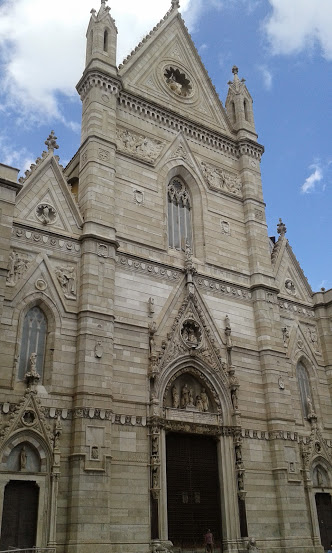
I happened upon the Cattedrale di San Gennaro (or the Duomo di Napoli) by chance, or perhaps the will of God, while on an impromptu trip to downtown Naples. After hours of walking down dark, narrow streets I suddenly found myself in an open square, flooded with light. At the back of the square sat the immense cathedral. It was clean, white, and ornately decorated, vastly contrasting the buildings surrounding it.
The square was silent when I arrived. It was the lunchtime riposo (siesta) and the piazza was deserted, even the church’s doors were closed to the public. Lucky for me, the museum next door, “The Treasures of San Gennaro”, was open (the tourist spots never close). Now, I don’t know about you, but put the word treasure in anything and I am sold. In I went.
I learned all the “treasures” inside were donated to the city of Naples in honor of San Gennaro, their patron saint. As the story goes, the saint was sentenced to death during the persecution of Christians under the Roman Emperor Diocletion. Legend has it that San Gennaro was thrown to the bears in the Flavean Amphitheater of Pozzuoli, but was untouched. After this failed attempt, the Emperor had him beheaded at the Solfatara Volcano that sits atop the town. Today the saint’s coagulated blood (which they still have in vials…) turns into liquid three times a year, and through this miracle the citizens of Naples know they are protected from the volcanoes that surround the city… Right then…
The relics in the museum were gold and silver statues of saints, jewel encrusted goblets, scepters, and grotesque oil paintings of the crucifixion. Everything was elaborate, shiny, beautiful, and creepy… so authentically Catholic.
There was one treasure that stood out above the rest. It was an emerald, diamond, and ruby encrusted miter made of gold. I learned each gem carried a symbolic meaning. The diamonds for an everlasting faith, the ruby for the blood of martyrs, and the emeralds for eternity and power. I don’t think I have ever seen that many valuable stones in one place, and upon later research I found that the collection is said to be worth more than the Crown Jewels. Now if only there hadn’t been security cameras…
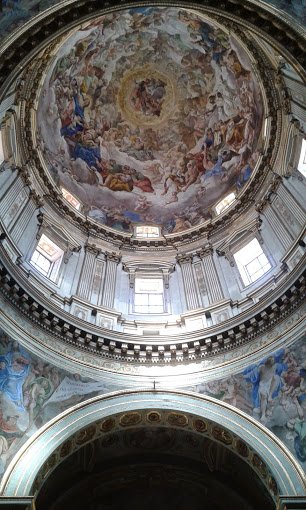
By the time I left the museum the Cathedral’s doors were open and I got to go inside. The interior was truly breathtaking. An arched ceiling painted with biblical scenes stretched from the door to an altar that must have stood 50 feet tall. Marble floors and stone columns, with multiple inlays along both sides to honor various saints. There was a second room of worship to the left and another to the right– both with domed, painted ceilings and colorful altars of their own. Below the cathedral’s main altar sits the crypt of San Gennaro, where in a small cup lay what are thought to be the bones from his skull. In all, the cathedral is a spectacular work of art. Turns out this is the Pope’s country after all.
When I returned home my curiosity was really piqued. I wanted to learn more about the saint and his voodoo blood. I jumped onto the internet and was able to connect the dots of what I learned in the museum!

The Blood of San Gennaro
San Gennaro was a Catholic priest that died during the Diocletian Persecution which ended in AD 305. He resided in the smaller town of Benevento, just outside of Naples. During his life Pagan religious traditions were still greatly practiced and many Christians were persecuted under the rule of Emperor Diocletian. When visiting his imprisoned Christian friends in Naples, San Gennaro was also arrested [1].
There are two versions of what happened next. The first is that the Emperor threw him to wild bears in the amphitheater here in Pozzuoli but the animals would not harm him. The other is that he was thrown into a furnace and not scathed by the flames. Whether either of these things happened or not, the Emperor did have San Gennaro beheaded [2].
According to the story, in AD 472 Vesuvius became active and giant ash clouds filled the sky. Many Christians went to the catacombs of San Gennaro and prayed to him, begging for his protection from the volcano. The city was saved, and the people named him their Patron Saint [3].
Shortly after he was beheaded one of his followers saved some of his blood; a very weird, but common practice during those times. This blood is stored in the famous vials now kept in the Cathedral. Three times a year people in the city of Naples gather to witness the liquefaction of his blood– on September 19th, the date of his death, December 16th, and on the Saturday before the first Sunday in May. During this gathering the vials of coagulated blood are brought out to the crowd. The crowd is shown that the blood is solid, and the Archbishop leads them in prayer. After the prayers, the coagulated blood turns into a liquid and is put on display for all to see. This is the miracle of San Gennaro [1].
There is a lot of speculation about the science behind the liquefaction of the blood. Many believe the substance in the vials is a chemical substance resembling blood which has a very low boiling point, making it a solid substance while stored in the cool Cathedral, and a liquid when brought out for the ceremony. The church, however, will not let scientists tamper with the precious material [4].
An interesting story, to say the least. Perhaps the liquefaction is a miracle after all. All I know is if it keeps the volcano from erupting, then pray on city of Naples!
1. Januarius
2. Treasures of San Gennaro Museum Tour
 roaming bull travels
I found this fascinating and must add this to my places to visit when in Italy.
LikeLike